
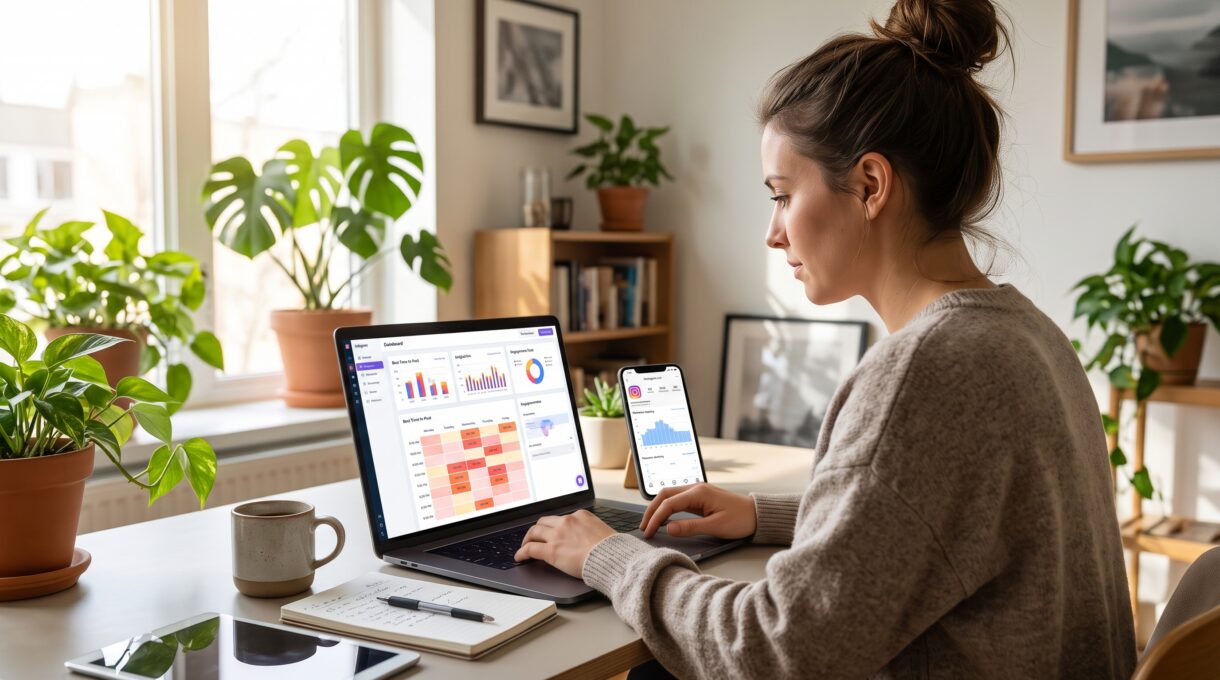
Every new client I onboard asks me the same question within the first ten minutes of our kickoff call. They want to know the best time to post on Instagram. Usually they have already googled it, found four different answers, and walked away more confused than when they started. One chart said 5 a.m. Another said noon on Wednesday. A third swore by evenings.
Here is the honest answer I give them, and the one I want to give you: there is a best time to post on Instagram for your account, and the published studies are where you start looking for it, not where you stop. After years of running accounts for consultancies, accounting practices, staffing agencies, and marketing firms, I have learned that timing is less about finding a magic hour and more about understanding how your audience lives their week.
In this guide I will walk you through what the major 2026 studies actually found, why they disagree, how Instagram’s ranking systems use timing, and the exact testing process I use to find the right posting windows for professional services brands.
Why the Best Time to Post on Instagram Still Matters in 2026
Some people will tell you timing is dead because the feed is no longer chronological. That is only half true. Instagram stopped showing posts in strict time order years ago, but the clock still matters in two important ways.
First, recency is a direct signal. In Instagram’s own explanation of how Feed ranking works, Adam Mosseri said the system looks at signals about how popular a post is, including how many people have liked it and how quickly people are liking, commenting, sharing and saving it, along with more basic details such as when it was posted. Notice that phrase about speed. Early engagement tells the system your post is worth showing to more people.
Second, the actions Instagram predicts all require a person to actually be on the app. According to Mosseri, the five Feed interactions Instagram weighs most closely are how likely someone is to spend a few seconds on a post, comment on it, like it, share it, and tap the profile photo. None of those happen if your audience is asleep, in a client meeting, or stuck in traffic when your post goes live.
So the goal is simple. Publish when enough of your people are scrolling to give the post a strong first hour. Everything else in this article is about figuring out when that is.
What the Big Studies Say About the Best Time to Post on Instagram
I pay attention to four large datasets every year because they come from scheduling platforms that see millions of real posts. Here is what each one found in its most recent release.
Sprout Social
Sprout Social leans heavily toward midweek afternoons. Its 2026 data puts the best times at Mondays 2 to 4 p.m., Tuesdays 1 to 7 p.m., Wednesdays 12 to 9 p.m. and Thursdays 12 to 2 p.m., with midweek afternoons producing the most consistent engagement. Wednesday stands out in their numbers, since the window runs from noon to 9 p.m. with an extra late night bump at 11 p.m., making it the peak of user activity.
They are just as clear about the weak spots. Fridays show no significant peak hours because people mentally check out for the weekend early, and Saturday delivers the lowest engagement of the entire week.
Buffer
Buffer published one of the biggest datasets I have seen. Their team analyzed 9.6 million Instagram posts from accounts active between January 2024 and December 2025, finding that Wednesday and Thursday produce the highest engagement and that evening hours from 6 p.m. to 11 p.m. win across most days. Their top three individual slots are Thursday at 9 a.m., Wednesday at 12 p.m., and Wednesday at 6 p.m.
What I like about Buffer’s data is that it agrees with Sprout on the days while adding a stronger case for evenings. That evening tilt matters a lot for certain audiences, which I will get to shortly.
Later
Later is the outlier, and people love to argue about it. According to Later, the overall best time to post on Instagram is 5 a.m., based on an analysis of over 6 million feed posts including images, videos, carousels, and Reels. Their reasoning is that an early post faces less competition and is waiting in the feed when people pick up their phones.
Later also pushes a point I agree with completely: consistency matters more than perfection, so aim for a predictable rhythm and adjust based on your own data.
Hootsuite
Hootsuite took a different angle by breaking the data down by industry and time zone. Their team partnered with Critical Truth to analyze over 1 million social posts to find the best posting times by day, industry, and time zone. If you serve clients in several regions, their time zone heatmaps are worth bookmarking.
Why Studies Disagree on the Best Time to Post on Instagram
When a client sees 5 a.m. from one source and 6 p.m. from another, the natural reaction is to assume someone got it wrong. Nobody got it wrong. They measured different things.
Each platform studies its own customer base. Later’s users skew toward creators and consumer brands. Sprout’s customers lean toward larger businesses and agencies. Buffer has a huge mix of small businesses and solo marketers. Those audiences behave differently, so the results differ.
The studies also measure slightly different outcomes. Some look at engagement rate, some at reach, some at median views. A post published at 5 a.m. might earn a higher engagement rate because fewer people are competing for attention, while a post at noon might reach more total people because more people are online. Both can be true at once.
This is good news because it confirms what experienced strategists already know. There is no universal hour. There are patterns, and then there is your audience. The studies give you a shortlist of smart hypotheses. Your own analytics settle the argument.
The Best Time to Post on Instagram for Professional Services Firms
Now let me get specific, because most of the brands I work with are in business and professional services. Think management consultants, IT service providers, accounting and bookkeeping firms, HR and staffing agencies, law practices, and marketing agencies.
These accounts have something in common. Their audience is usually made up of business owners, managers, and decision makers who check Instagram in the gaps of a working day. Research from Kolsquare backs this up, noting that fashion content does well in evenings and on weekends, while B2B content performs better during work hours.
The Windows That Work for B2B Audiences
In practice, here is what I see across professional services accounts.
- The lunch window is the anchor. Between roughly 11:30 a.m. and 1:30 p.m. local time, Tuesday through Thursday, is where I start almost every B2B client. It lines up with Sprout’s midday windows and Buffer’s Wednesday noon slot.
- Early weekday mornings work for owners and executives. Founders and partners often scroll before the office gets busy. That is why Buffer’s Thursday 9 a.m. slot tends to perform well for consulting and advisory brands.
- Evenings work when your audience includes job seekers or small business owners. Staffing agencies, for example, often see strong evening engagement because candidates browse openings after work. Small business owners who run the shop all day also tend to catch up on content at night.
- Weekends are usually weak for pure B2B. Unless you serve hospitality, retail owners, or contractors who plan their week on Sunday night, I rarely schedule anything important for Saturday.
A Real Example from a Staffing Client
One of my staffing clients is a good example. We started with the classic lunchtime schedule because the data said so. Engagement was fine but not great. When we looked at their Insights, a large share of their followers were candidates rather than hiring managers, and those candidates were most active after 7 p.m.
We moved job posts and career tips to evenings and kept employer focused content at lunch. Same content quality, noticeably better results, simply because we stopped posting for the audience we assumed and started posting for the audience they actually had.
Best Time to Post on Instagram by Format: Reels, Carousels, and Stories
Not every format behaves the same way, because Instagram ranks each surface differently.
Best Time to Post Reels on Instagram
Reels are the main discovery tool on Instagram right now. According to Instagram, many of the Reels a person sees come from accounts they do not follow, with an emphasis on entertainment, and the ranking works much like the Explore page. That means timing for Reels is less about your followers and more about broad platform activity.
Sprout’s data says the best times for Reels mirror the overall top windows: Mondays 2 to 4 p.m., Tuesdays 1 to 7 p.m., Wednesdays 12 to 9 p.m. and Thursdays 12 to 2 p.m. Later, meanwhile, found a very different peak, reporting that Reels earned the highest engagement when posted at 12 a.m. on Mondays.
My take: for professional services brands, I post Reels in the early afternoon on Tuesday or Wednesday and let them build for several days. Reels have a longer life than feed photos, so the first hour matters, but not as much as it does for a static post.
A quick warning that has nothing to do with timing but everything to do with reach. Instagram has said it aims to show fewer low resolution or watermarked reels, reels that are muted or contain borders, and reels that are mostly text. If you repurpose a video from another app with its watermark still on it, the perfect posting time will not save it.
Best Time to Post Carousels on Instagram
Carousels are my favorite format for professional services because they are perfect for frameworks, checklists, and quick lessons. People save them and come back to them. Later found that the best time to post carousels is 5 a.m., and that Tuesday is the strongest day for them.
I have had good results scheduling educational carousels early on Tuesday or Thursday mornings for consulting and accounting clients. Decision makers see them during their first scroll of the day, save them, and often share them with a colleague.
Best Time to Post Instagram Stories
Stories follow different rules because they mostly reach people who already follow you. Instagram ranks them based on viewing history, engagement history, and closeness with the poster. The practical lesson is that relationship matters more than the clock here. I spread Stories across the day, a couple in the morning, one at lunch, and one in the evening, so the account stays near the front of the tray for the people who interact with it most.
A Starting Schedule I Use with New B2B Clients
If you want a place to start tomorrow, here is the baseline schedule I give most professional services accounts before we have any data of our own. All times are in your audience’s local time zone.
- Monday, 2 p.m. A light post that sets up the week: an industry insight, a quick tip, or a team update.
- Tuesday, 8 a.m. An educational carousel aimed at owners and executives.
- Wednesday, 12 p.m. Your strongest piece of the week. A Reel or a carousel you expect to perform.
- Thursday, 9 a.m. A case study, client story, or proof point.
- Thursday or Wednesday, 6 p.m. An evening test post, especially if your audience includes job seekers or small business owners.
Stories run daily. Fridays and weekends stay quiet unless the data tells me otherwise.
This schedule borrows the strongest overlapping windows from Sprout and Buffer and adds one early morning slot to test Later’s theory. It is not meant to be permanent. It is meant to give you clean data within a month.
How to Find Your Own Best Time to Post on Instagram in 30 Days
This is the part most articles rush through, and it is the part that actually matters. Here is the process I run with every new account.
Step One: Study Your Audience Data
- Check your audience’s most active times. Open your Professional Dashboard, go to your followers in Insights, and look at the most active times section. It shows when your followers are on the app by hour and by day. This is the closest thing you will get to a personal answer straight from Instagram.
- Confirm your followers’ time zone. Insights also shows your top cities and countries. If you are based in Manila but half your clients are in Sydney or Los Angeles, your posting time needs to reflect where they are, not where you are. This mistake is far more common than people think.
- Pick three to four candidate windows. Combine what your Insights show with the study data above. For a B2B account, that usually looks like one early morning slot, one lunch slot, one afternoon slot, and one evening slot.
Step Two: Test, Measure, and Repeat
- Rotate them for four weeks. Post the same type of content in each window so you are comparing timing, not content quality. If you post your best carousel at noon and a weak photo at 6 p.m., you have learned nothing.
- Measure the right numbers. Look at reach, saves, shares, and profile visits within the first 24 hours. Likes are nice, but saves and shares are stronger indicators that a post landed with the right people. Over time, tie these back to leads and revenue so you can measure social media ROI, not just engagement.
- Keep the winners and test again every quarter. Audience habits shift. A new hiring season, a product launch, daylight saving changes, or a shift in your follower base can all move your best window. I revisit timing every three months for every client.
A scheduling tool helps here. Most of the platforms I mentioned have built in features that suggest optimal times based on your own history. They are useful, but I still check the numbers myself before trusting any recommendation. If you outsource this work, ask any provider of social media marketing agency services how they test posting times for your account.
Mistakes That Kill Reach Even When Your Timing Is Right
I have audited a lot of accounts that nailed their posting times and still struggled. Usually it comes down to one of these.
Habits That Undo Good Timing
Posting and disappearing. If people comment in the first hour and you do not reply, you lose momentum. I tell clients to stay on the app for at least 15 to 30 minutes after a post goes live. Replies create more comments, and more comments help the post keep moving. If your team cannot spare that time, community management is a common line item in social media management pricing.
Chasing the perfect hour over consistency. Posting at the ideal time once a month will not beat posting at a decent time three times a week. Instagram rewards accounts that show up reliably, which is the foundation of any effort to grow on Instagram organically.
Copying global data blindly. A study built on millions of consumer brand posts may not reflect how a CFO or HR director uses Instagram. Use the studies as a starting point, then trust your own numbers. It is also a good question to ask when you choose a social media agency: do they test timing for your audience or copy a chart?
Content Problems Timing Cannot Fix
Ignoring the content itself. Timing amplifies good content. It does not fix weak content. A generic stock photo with a vague caption will underperform at any hour. This is one reason creator content, the core of influencer marketing for small business, often outperforms polished brand posts.
Forgetting the hook. Instagram is watching whether people stop and spend a few seconds on your post. If the first frame of your Reel or the first slide of your carousel does not give someone a reason to pause, the time you posted will not matter.
Final Thoughts on the Best Time to Post on Instagram
The best time to post on Instagram is not a single number you copy from a chart. It is a pattern you discover by combining solid industry research with your own audience data. For most business and professional services brands, that pattern will land somewhere in midweek mornings and lunch hours, with evenings worth testing if your audience includes candidates or small business owners.
Start with the windows the research agrees on. Watch your Insights closely. Test with discipline for a month. Then build your calendar, and your wider social media marketing strategy, around what your people actually do, not what a heatmap says the average person does. That shift alone has done more for my clients’ reach than any hack I have ever tried.
Frequently Asked Questions
What is the best time to post on Instagram in 2026?
Based on the largest recent studies, midweek is the safest bet. Buffer’s analysis of 9.6 million posts named Thursday at 9 a.m., Wednesday at noon, and Wednesday at 6 p.m. as top slots, while Sprout Social highlights Monday through Thursday afternoons. You can read the full breakdowns in Buffer’s Instagram timing study and Sprout Social’s best times guide.
What is the best day to post on Instagram for business accounts?
Wednesday and Thursday tend to be the strongest days across most datasets, with Saturday usually the weakest. For B2B brands, weekdays during working hours generally perform best. Sprout Social’s 2026 data covers this day by day.
Does posting time really affect the Instagram algorithm?
Yes. Instagram has confirmed that it considers when a post was published and how quickly people interact with it. Posting when your audience is active gives your content the early engagement that helps it reach more people. See Instagram’s official ranking explanation for details.
What is the best time to post Reels on Instagram?
Studies disagree. Sprout Social recommends weekday afternoons, while Later found strong results just after midnight on Mondays. For professional services brands, early afternoon on Tuesday or Wednesday is a reliable starting point. Compare both views in Later’s Instagram timing research.
How do I find my own best time to post on Instagram?
Check the most active times section in your Instagram Insights, confirm where your followers are located, then test three or four posting windows over a month while keeping content quality consistent. Hootsuite’s guide also breaks down timing by time zone and industry.
Should I post on Instagram on weekends?
For most B2B and professional services accounts, weekends are the weakest days. Consumer brands, hospitality, and lifestyle accounts may see better weekend results. Test before you rule it out completely, and use Kolsquare’s posting time guide to see how results vary by sector.
References
- Best Times to Post on Instagram in 2026, Sprout Social
- Best Time to Post on Instagram in 2026: New Data from 9.6 Million Posts, Buffer
- Best Time to Post on Instagram in 2026, Later
- The Best Time to Post on Instagram, Hootsuite
- Instagram Ranking Explained, Instagram
- Instagram Explainer on Feed, Reels and Stories Ranking, Social Media Today
- What Are the Best Times to Post on Instagram, Kolsquare.